Smart Irrigation: 3-Stage ML Pipeline & ICCC Integration
Chained Forecasting, Decisioning & Duration Microservices
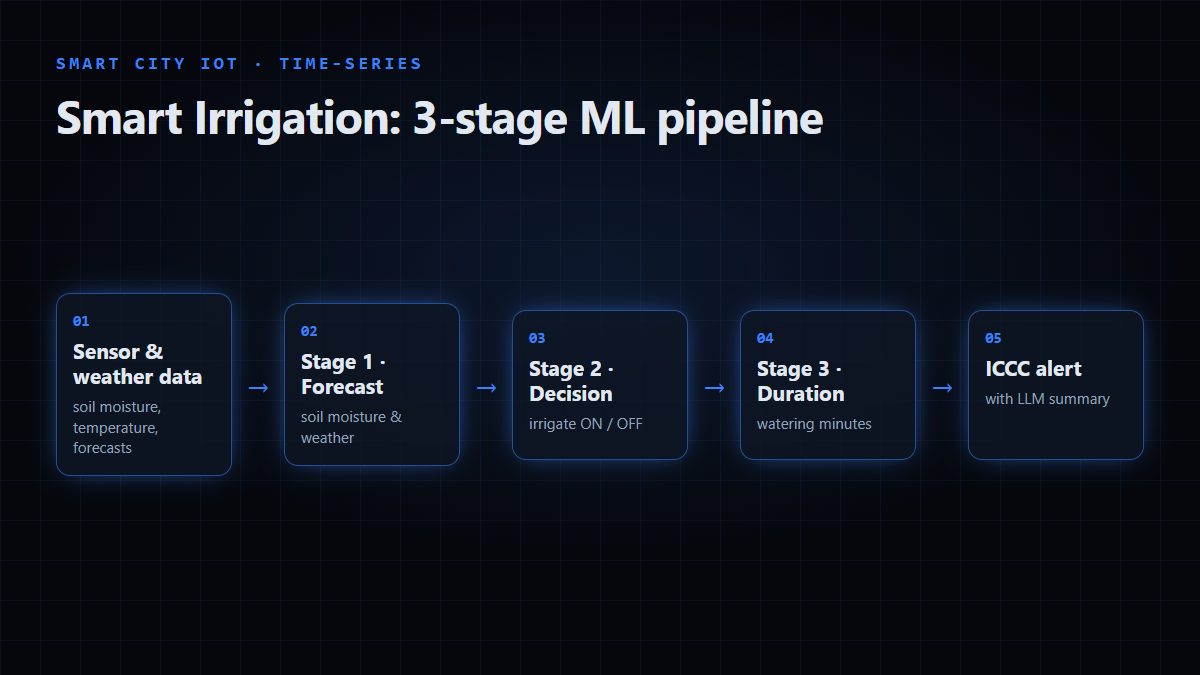
Key contributions
- Engineered sequential 3-stage architecture where each stage feeds the next, returning a complete operational command.
- Integrated trained models into FastAPI microservices with Pydantic request models and automated validation.
- Published irrigation alerts with short AI-generated summaries to the ICCC platform for operators.
Applied Machine Learning Engineering Specification
Structured technical analysis conforming to production machine learning standards.
Problem Formulation
Municipal smart city irrigation systems suffered from disjointed manual controls, risking water waste, over-saturation, and high electricity bills due to lack of automated end-to-end decision-making.
Data Ingestion & Feature Space
Multi-parameter sensor telemetry including historical soil moisture, ambient temperature, humidity, solar radiation, forecasted precipitation, and municipal zone schedules.
Preprocessing & Methodology
Formulated a 3-stage chained workflow: Stage 1 forecasts soil moisture & meteorological parameters; Stage 2 evaluates threshold triggers to classify whether irrigation is required (ON/OFF); Stage 3 regresses the precise watering duration in minutes.
Model Architecture & Training
Time-series forecasting models combined with Gradient Boosted Classifiers and duration regressors, orchestrated as an integrated pipeline.
Validation & Evaluation Protocol
Benchmarked end-to-end latency, stage-to-stage error propagation, classification precision for valve activation, and duration calibration.
Empirical Results & Discoveries
Replaced disconnected manual checks with a single atomic API call returning an actionable irrigation command, complete with predictive confidence metrics.
Production & Business Impact
Integrated directly with the municipal Integrated Command and Control Center (ICCC), delivering automated alerts and plain-language AI summaries to city operators.