ML Composer: Enterprise No-Code Machine Learning Platform
Automated Ingestion, Model Validation & Nexus Registry CI/CD
Key contributions
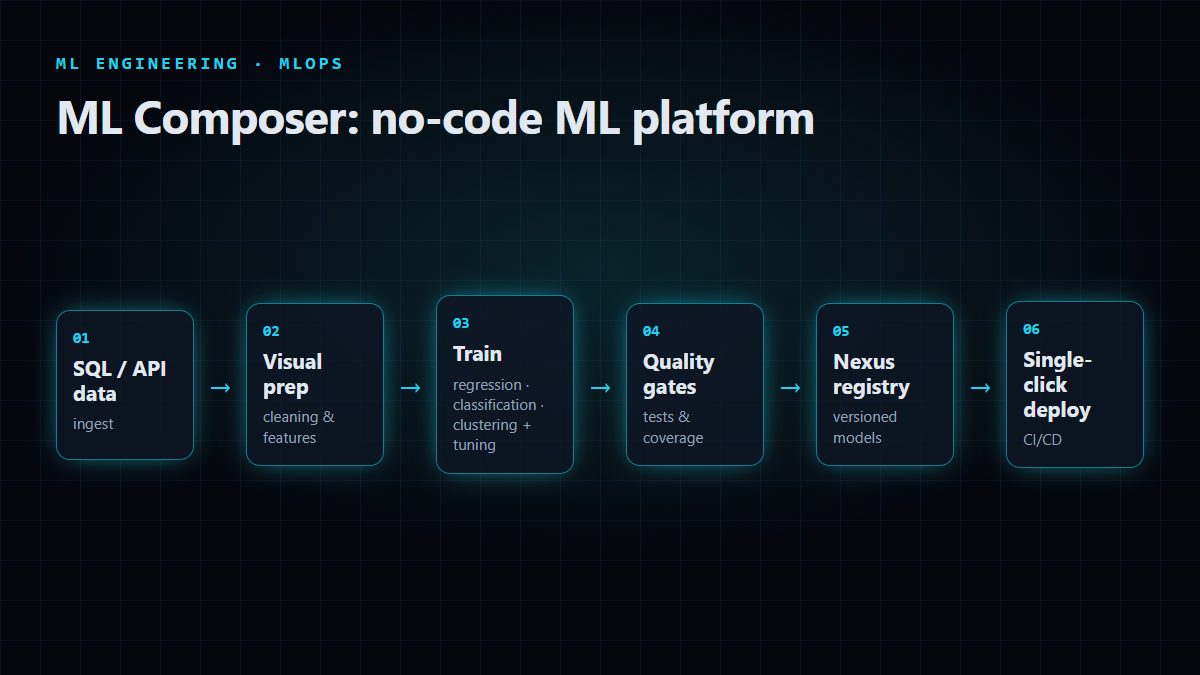
- Designed Model Registry and Nexus integration workflow for centralized model storage, versioning, and reuse.
- Built a reusable pretrained-model CI/CD module with single-click deployment, eliminating manual setup overhead.
- Enabled end-to-end automated testing and code coverage within the Flask-service quality gate.
Applied Machine Learning Engineering Specification
Structured technical analysis conforming to production machine learning standards.
Problem Formulation
Domain and engineering teams faced severe bottlenecks deploying ML models: lack of automated testing, scattered model versions, and slow, repetitive manual configuration for every release.
Data Ingestion & Feature Space
Ingestion pipelines connecting relational databases (SQL), big data streams (PySpark), REST APIs, and multi-format local files (CSV, Parquet, JSON).
Preprocessing & Methodology
Constructed a visual data preparation workflow with automated feature engineering, linked to an MLOps pipeline with automated validation, drift monitoring, and strict quality gates.
Model Architecture & Training
Modular algorithm library supporting regression, classification, and clustering with automated hyperparameter search and model evaluation.
Validation & Evaluation Protocol
Integrated MLflow tracking, Evidently AI data-drift detection, and automated test execution with code coverage gates on every build.
Empirical Results & Discoveries
Unified model storage in a Nexus-backed Model Registry and introduced a single-click CI/CD deployment workflow that eliminated repeated manual setups.
Production & Business Impact
Standardized model governance across smart city engineering teams, ensuring consistency and preventing flawed models from reaching production.
Tech stack
Want to see the source code?
Access the complete Jupyter notebook, preprocessing routines, and evaluation logs.